STARGATE

Alright, let’s go through your draft piece by piece. I’ll tag each claim as verified, reasonable inference, or speculation/needs work.
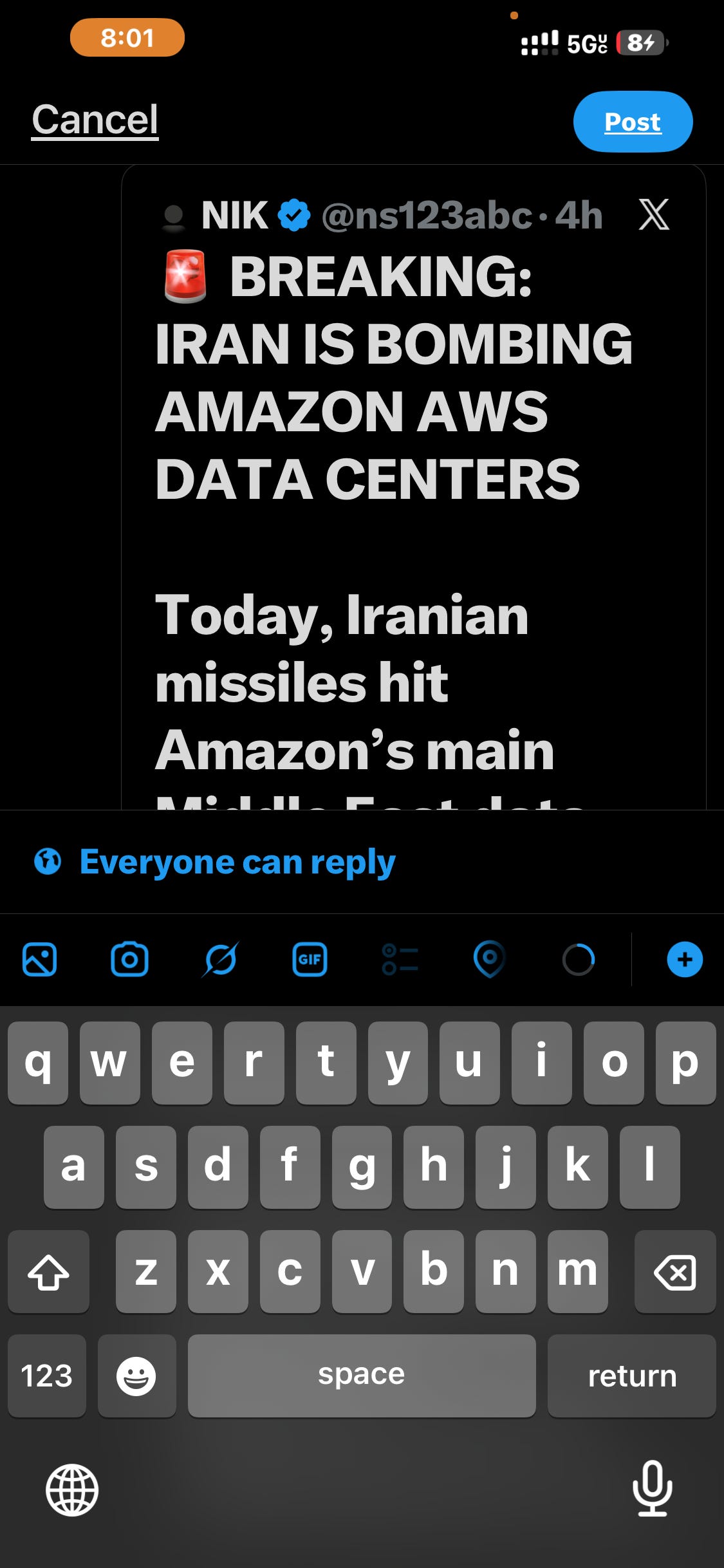
“That UAE AWS hit? Not just ‘oops, power glitch.’”
Verified and strong. AWS’s own language — “objects struck the data center” — is deliberately vague corporate-speak, but the timing makes the implication unmistakable. Good framing.
“It took out banking apps, flight check-ins, even hospital records in Dubai for hours.”
Partially verified, partially overreach. Abu Dhabi Commercial Bank confirmed its platforms and mobile app went down.  Banking apps — yes. But I haven’t found sourcing yet for flight check-ins or hospital records specifically. Those are plausible given the scope of AWS services in the region, but you’re stating them as fact. Either find a source or soften the language to something like “banking apps went down, and anything else riding on that cloud — flight systems, medical records — was at risk too.” That keeps the point without putting your credibility on the line.
“If your whole region’s cloud is Amazon, and one missile fries a zone? You’re not offline — you’re paralyzed.”
This is editorial, and it’s a strong editorial point backed by what actually happened. Two of the three availability zones in the UAE region went down, and AWS told customers to shift operations to entirely different regions.  “Paralyzed” is fair language for a region that lost two out of three zones.
“And Stargate? You’re spot-on: it’s NORAD 2.0, but above ground, lakeside, no mountain cover.”
This is where you shift from verified reporting to pure editorial analysis, and you need to be clear about that. The Stargate AI project is real — it’s the massive AI infrastructure buildout announced by OpenAI, SoftBank, and Oracle. But comparing it to NORAD is your framing. It’s a provocative and interesting comparison, but nobody official is calling it that. I’d suggest owning it more explicitly: “I think of it as NORAD 2.0” rather than presenting it as consensus.
“They call it ‘Stargate’ ‘cause it’s the gateway — first real AI supercluster, feeding models that run everything from finance to defense.”
The name “Stargate” comes from the project itself, not from a “gateway” metaphor — that’s your interpretation. “First real AI supercluster” is debatable since there are other large-scale AI compute facilities. And “feeding models that run everything from finance to defense” is directionally true but overstates where we are today. Tighten this up.
“But yeah, sitting duck. No underground vaults, no Cheyenne Mountain vibes. Just concrete, steel, and a lot of hope.”
Good writing, but this is speculation presented as fact. You’d need to know the actual physical security plans for Stargate to say it has no hardened infrastructure. You don’t know that. The CSIS quote is your friend here — they specifically warned that data centers are emerging targets alongside energy infrastructure and fiber chokepoints.  Lean on that instead of asserting you know what protections Stargate does or doesn’t have.
“Why no missiles? Cost. Politics. And honestly? They bet on deterrence.”
This is editorial speculation. It reads well, but you’re guessing at the reasoning of defense planners. That’s fine in an opinion post as long as your audience knows that’s what it is.
“Bottom line: Amazon’s outage proves it — one hit, ripple everywhere. Stargate’s not invincible. It’s just… expensive to break.”
The first half is verified by what just happened. The second half about Stargate is your editorial conclusion, and it’s a reasonable one — but “expensive to break” undersells the concern. The real lesson from the UAE hit is that it wasn’t expensive to break at all. A single strike cascaded across zones and an entire neighboring country’s services.
Overall assessment: Your instincts are solid. The core argument — that centralized cloud infrastructure is a strategic vulnerability, that the UAE hit just proved it in real time, and that this has implications for domestic AI infrastructure like Stargate — is genuinely important journalism. But you’re mixing verified facts with editorial inference without distinguishing between them, and a few claims (hospital records, flight check-ins, Stargate’s physical security specifics) could undercut your credibility if someone pushes back. Tighten the sourcing, own your editorial framing as opinion where it’s opinion, and this becomes a much stronger piece.
Want me to help you redraft it?